
Picture a Fairfax IT firm that wins its first task order at Fort Belvoir, only to have the contracting officer pause performance because the certificate of insurance lists the wrong limits and omits the required policy notice language. Situations like this occur regularly across Northern Virginia, where federal spending supports thousands of small and mid-sized businesses, and where a single paperwork deficiency can delay mobilization by weeks.
Understanding insurance requirements for
Virginia federal contractors means reconciling three separate rulebooks: the Federal Acquisition Regulation (FAR), Virginia state law, and the specific terms written into Your contract. Each one imposes obligations, and none of them fully replaces the others. The guidance below walks through the clauses, limits, registration steps, certificates, and coverage gaps that most often trip up contractors. It is intended as general educational information rather than legal advice, and every contract should be reviewed against its own terms.
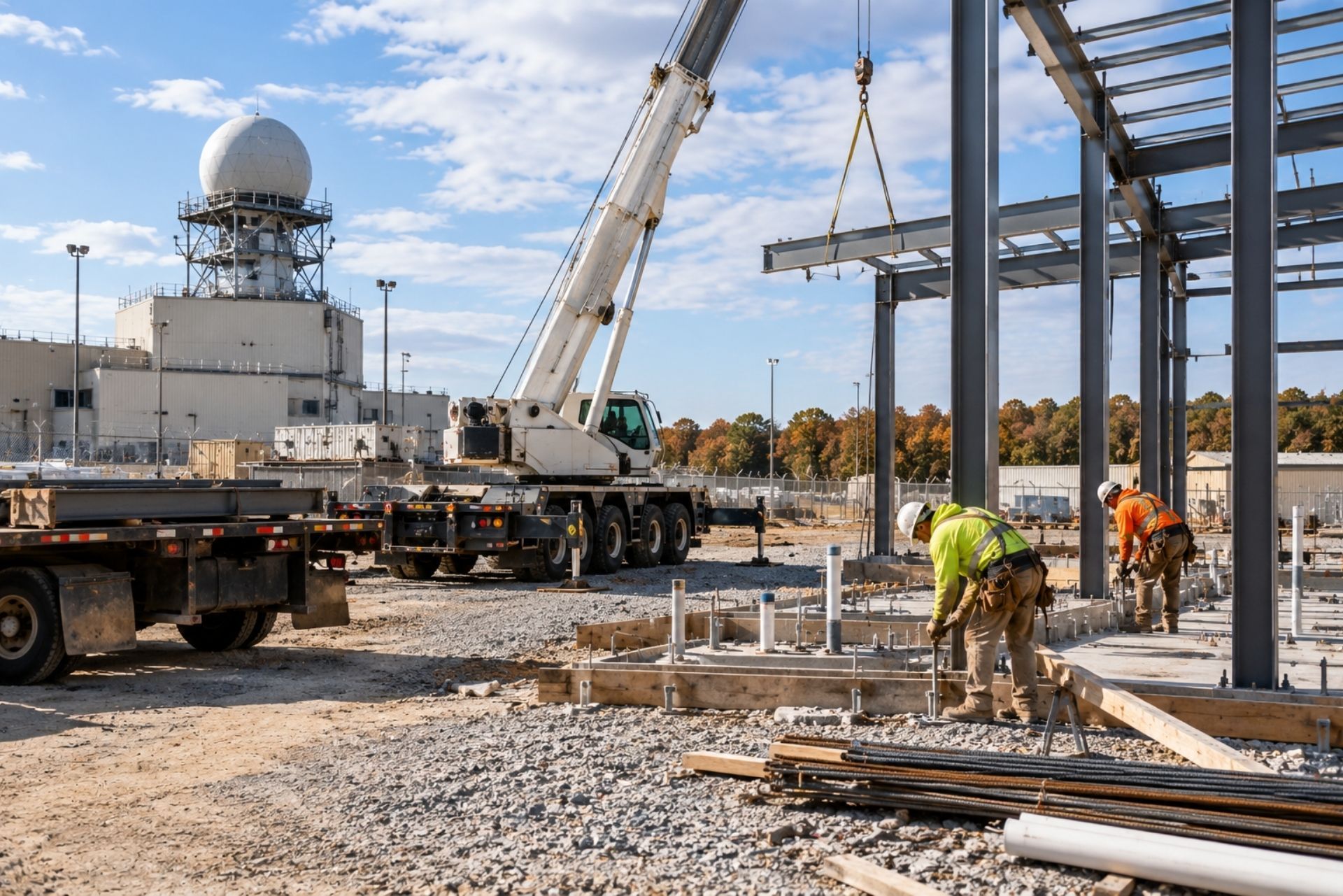
Virginia occupies an unusual position in federal contracting. The Pentagon, dozens of agency headquarters, Naval Station Norfolk, Quantico, and countless leased facilities create a dense concentration of work performed directly on government property, which is precisely the situation that triggers mandatory insurance obligations.
The government's general posture is less demanding than many contractors assume. A recent overhaul clarifies that the government is generally not concerned with a contractor's private insurance on fixed-price contracts, yet insurance becomes mandatory when work is performed on a government installation or involves government property. On August 15, 2025, the FAR Council released a plain language revision of FAR Part 28, which governs bonds and insurance, and that revision now shapes how contracting officers read and apply these clauses in 2026.
Here is what that means for You: a software firm delivering code remotely under a fixed-price contract may face few federal insurance mandates, while a janitorial crew cleaning offices at the Pentagon faces several. The difference lies in where the work occurs and what type of contract governs it. Cost-reimbursement contracts carry additional rules because the government is effectively paying for Your insurance and therefore cares a great deal about it.
Virginia then layers its own requirements on top, including workers' compensation mandates and auto minimums enforced through the State Corporation Commission and the Department of Motor Vehicles. Federal clauses do not excuse You from state law, and state compliance does not satisfy federal clauses.

By: Keri Park
Director of Client Experience
Core Federal Acquisition Regulation (FAR) Insurance Clauses
Two clauses appear most frequently in Virginia contracts, and each serves a distinct purpose. Reading the actual clause incorporated into Your contract, including any agency supplements such as the DFARS for defense work, should always precede any insurance purchase.
FAR 52.228-5: Work on a Government Installation
This clause applies to fixed-price contracts requiring work on a government installation, and it is the clause most Virginia contractors encounter first. It requires You to obtain and maintain, at Your own expense, the insurance specified in the contract for the entire period of performance.
The clause carries several practical obligations:
- Written proof before work begins: You must notify the contracting officer in writing that the required insurance has been obtained.
- Advance notice of changes: Policies must contain an endorsement stating that cancellation or material changes will not take effect until a specified notice period has been given to the government.
- Flow-down to subcontractors: You must insert the substance of the clause into subcontracts involving work on the installation and maintain a current certificate for each subcontractor.
A common mistake involves the flow-down requirement. A prime contractor may carry compliant coverage while an electrical subcontractor working in a secured building at Quantico carries only state minimum auto limits and no endorsement, leaving the prime in technical breach.
FAR 52.228-7: Insurance Liability to Third Persons
This clause governs cost-reimbursement contracts, and it operates differently. The government reimburses You for allowable insurance costs and, under certain conditions, for liabilities to third persons that exceed or fall outside Your insurance, including but not limited to claims for death, bodily injury, or property damage.
That protection is conditional. Reimbursement generally does not extend to liabilities caused by willful misconduct or lack of good faith by Your managerial personnel, and You must promptly notify the contracting officer of any claim or suit. You should also expect the government to scrutinize premiums for reasonableness, so the coverage You purchase must align with contract requirements rather than exceeding them without justification.
Mandatory Coverage Types and Minimum Limits
The federal baseline is set out in FAR 28.307-2, though Your contract may require higher amounts. Contracting officers in Virginia frequently specify limits above the regulatory floor, particularly for facilities involving sensitive operations.
General Liability and Virginia Workers' Compensation
Under the regulation, baseline federal minimums include $500,000 per occurrence for general liability bodily injury and $100,000 for employer's liability. General liability responds to scenarios such as a visitor tripping over cabling Your technicians ran across a hallway at a federal building in Arlington, or a ladder damaging a government-owned conference room ceiling.
Workers' compensation brings state law into play. Virginia requires employers with three or more employees to carry workers' compensation insurance under Title 65.2 of the Code of Virginia. The catch is that the federal clause typically requires workers' compensation and employer's liability regardless of headcount, so a two-person firm exempt under state law may still need a policy to satisfy its contract.
Virginia also applies statutory employer principles, meaning a prime contractor may be held responsible for injuries to an uninsured subcontractor's employees. The Commission publishes guidance specific to contractors that every prime should review before hiring subcontractors.
Automobile Liability and Aircraft Requirements
The federal floor for automobile coverage includes $20,000 for property damage, alongside bodily injury limits set in the same regulation. Virginia's own minimums are higher in some respects: as of January 1, 2025, Virginia requires 50/100/25 liability limits, and uninsured/underinsured motorist coverage is required rather than optional. Virginia is an at-fault state, so a collision involving Your service van on the Beltway exposes Your business directly to the injured party's claim.
Your vehicles must satisfy whichever standard is higher, and in practice most contractors carry commercial auto limits well above either floor. Medical Payments coverage is a sensible addition for crews traveling between installations, and Custom Parts and Equipment coverage protects upfitted vans carrying specialized diagnostic or communications gear.
Aircraft liability arises less frequently but applies when contracts involve operating aircraft, including unmanned aerial systems used for surveying or inspection. Standard commercial policies typically exclude aircraft, so drone work requires a separate aviation policy.

Comparison of Standard vs. Federal-Specific Coverage
Many contractors assume their existing commercial package satisfies federal requirements. The table below highlights where a typical small business policy differs from what federal work commonly demands.
| Coverage Element | Standard Commercial Policy | Federal Contract Expectation |
|---|---|---|
| General liability | Limits chosen by owner | At least $500,000 per occurrence for bodily injury |
| Workers' comp | Required at 3+ employees in Virginia | Usually required regardless of headcount |
| Employer's liability | Often minimal | At least $100,000 |
| Auto liability | Virginia 50/100/25 minimum | Higher of federal floor or state minimum |
| Cancellation notice | Insurer notifies named insured | Endorsement giving government advance notice |
| Subcontractor coverage | Rarely verified | Flow-down and certificate tracking required |
| Professional liability | Optional | Often specified for IT and consulting |
| Cyber liability | Optional | Increasingly expected for CUI handling |
The most significant differences involve endorsements and documentation rather than dollar amounts. A contractor may already carry $1 million in general liability, yet still fall out of compliance because the policy lacks the notice endorsement or the certificate omits the correct agency information. One thing to keep in mind is that higher limits never cure a missing endorsement.
SAM.gov Registration and Compliance Reporting
SAM.gov registration is the gateway to every federal award, and Your representations and certifications must stay current. The system now uses a modernized Reps and Certs module that consolidates previously scattered screens and includes a dedicated section for Department of Defense certifications, which matters for the many Virginia firms supporting defense agencies.
SAM.gov does not collect Your insurance policies directly, but the information You certify there connects closely to insurance obligations. Your business size, ownership status, and entity details must match the named insured on Your policies, because a mismatch between the legal name in SAM.gov and the name on Your certificate is a frequent cause of rejected submissions.
By mid-2026, the SAM.gov interface absorbed the Electronic Subcontracting Reporting System and the Federal Procurement Data System, centralizing subcontracting reports that previously lived on separate platforms. For primes, this consolidation makes subcontractor relationships more visible to contracting officers, which raises the stakes for proper insurance verification across Your supply chain.
A practical registration routine includes:
- Renewing Your SAM.gov registration annually and well before expiration;
- Confirming that Your legal business name, address, and Unique Entity ID match Your insurance documents exactly;
- Updating Reps and Certs whenever ownership, size status, or structure changes;
- Notifying Your insurance agent of any entity changes so policies can be endorsed accordingly.
Compliance with the minimum clauses does not equal adequate protection. Most uninsured losses in federal contracting arise from exposures the FAR never mentions, and these common gaps deserve careful review before You sign any task order.
Professional Liability vs. General Liability Gaps
General liability covers bodily injury and property damage; it does not cover financial losses caused by errors in Your professional work. If Your engineering firm miscalculates load requirements on a renovation design, or Your IT consultants misconfigure a system that causes an agency to miss a deadline, the resulting claim is typically excluded from general liability.
Professional liability, also called errors and omissions, fills this gap. Many Virginia task orders for consulting, systems integration, and engineering specify professional liability limits, while others omit it entirely even though the exposure is obvious. Claims-made policy forms add another nuance: switching carriers without securing prior acts coverage can leave earlier projects unprotected, and underwriters generally review a five-to-seven-year claims history when pricing renewals.
Cyber Liability and CMMC Compliance Needs
Defense contractors handling Controlled Unclassified Information face Cybersecurity Maturity Model Certification obligations, and a breach can trigger notification costs, forensic investigations, regulatory scrutiny, and contract consequences. Standard general liability policies typically exclude data breaches and electronic data losses.
Cyber liability coverage addresses first-party costs such as forensics, data restoration, and business interruption, along with third-party claims arising from compromised information. Underwriters increasingly ask about multifactor authentication, endpoint detection, and incident response planning, so Your CMMC preparation and Your cyber insurance application should be developed together rather than in isolation.
Defense Base Act (DBA) Insurance for Overseas Work
Virginia contractors supporting missions abroad often overlook the Defense Base Act, which requires workers' compensation coverage for employees working outside the United States under qualifying government contracts. A Virginia workers' compensation policy does not satisfy this obligation.
DBA coverage applies to contractors and subcontractors alike, including local and third-country nationals hired for the project. Failure to secure it can expose Your business to direct liability for injury benefits, so any contract involving overseas performance should prompt an immediate conversation with Your agent.
Managing Certificates of Insurance (COI) for Prime and Subcontractors
The certificate of insurance is the document contracting officers actually see, and it is where many compliance problems surface. A certificate is evidence of coverage, not coverage itself; it confers no rights on the certificate holder and does not amend the underlying policy.
For primes, effective certificate management follows a disciplined sequence:
- Collect before mobilization: Require compliant certificates from every subcontractor before anyone sets foot on the installation.
- Verify against the contract: Compare limits, coverage types, and endorsements to the specific clause requirements, not to a generic checklist.
- Request endorsements, not just certificates: Ask for copies of notice of cancellation and additional insured endorsements where required.
- Track expiration dates: Maintain a calendar or tracking system and request renewals at least thirty days ahead.
- Retain records: Keep certificates on file for the duration of performance and any audit period specified in the contract.
Subcontractors should expect primes to request detailed documentation and should respond promptly. A common client mistake involves a subcontractor presenting a certificate issued months earlier, after a mid-term policy change reduced limits. Requesting a fresh certificate for each new project reduces that risk considerably.
Frequently Asked Questions About Virginia Federal Contracting
Do I need insurance if my federal contract is fixed-price and remote? Federal rules generally do not require insurance on fixed-price contracts unless work occurs on a government installation or involves government property. Your contract may still specify coverage, and Virginia law still applies.
My business has two employees. Do I still need workers' comp? Virginia law requires coverage at three or more employees, but federal clauses often require it regardless of size. Check Your contract before assuming You are exempt.
Will my personal auto policy cover a work truck used on a base? Usually not. Business use of vehicles generally requires a commercial auto policy meeting both federal and Virginia limits.
How quickly can I get a certificate of insurance? Once coverage is bound, a certificate can often be issued within one business day. Endorsements may take longer, so plan ahead.
Does SAM.gov verify my insurance? No. SAM.gov handles registration and certifications, while insurance proof goes directly to the contracting officer or prime contractor.
Is cyber insurance required for defense contracts? It is not universally mandated by FAR, but it is strongly advisable for firms handling Controlled Unclassified Information under CMMC.
Federal contract compliance in Virginia rests on matching the right clause to the right coverage: FAR 52.228-5 for installation work, FAR 52.228-7 for cost-reimbursement arrangements, the federal minimums for liability and auto, and Virginia's own workers' compensation and auto rules. Beyond those floors, professional liability, cyber coverage, and Defense Base Act insurance close the gaps that cause the most expensive surprises.
ABP Insurance Agency, Inc. compares policies from multiple carriers and supports clients in English, Spanish, Vietnamese, Korean, Mandarin, Cantonese, Hindi, Punjabi, and Urdu, which helps diverse Virginia contracting teams review complex requirements with confidence. All coverage remains subject to policy terms, conditions, and underwriting approval.
Get in touch to request a free quote or speak with a multilingual agent before Your next bid deadline. Confirming coverage before award costs far less than correcting it after a stop-work notice arrives.
Our Reviews
Trusted Advice, Proven Results
See what our clients have to say about their experience working with us, or share feedback about your experience.

PERSONAL INSURANCE
Protect What Matters Most
Home, auto, and life coverage at competitive rates from 25+ carriers.
Home Insurance
Covers your home and belongings from events like fire, theft, or storms. Ensures peace of mind with clear, reliable coverage for houses, condos, apartments, and rentals
Auto Insurance
Covers vehicle repairs, liability, and medical costs from accidents. Protects you and your car with easy-to-understand policies that meet Virginia requirements.
Umbrella Insurance
Provides extra liability coverage beyond home and auto policies. Adds protection for unexpected situations that exceed your standard policy limits.
Renters Insurance
Covers your personal belongings and provides liability protection if you rent your home. Replaces items damaged by fire, theft, or water at a low monthly cost.
Condo Insurance
Fills the coverage gaps your HOA master policy leaves open. Protects your unit's interior, personal property, and liability from covered losses.
Classic & Specialty Vehicles
Coverage for classic cars, motorcycles, ATVs, boats, and RVs. We partner with specialty carriers like Hagerty to protect vehicles that standard auto policies do not cover.
BUSINESS INSURANCE
Secure What You've Built
Coverage solutions for growing companies backed by decades of commercial experience.






INDUSTRIES WE SERVE
Virginia's Businesses We Protect
Insurance solutions to help Virginia businesses protect their assets, employees, and operations.



FAQs
Your Questions, Answered
Explore our FAQs to get answers to some of the most common questions about our insurance solutions and services.
What languages do your agents speak?
We have agents who are fluent in Spanish, Vietnamese, Mandarin, Cantonese, Korean, Hindi, Urdu, and Punjabi. If you prefer a language other than English, just let us know!
Who do you typically work with?
We work with clients at all stages of life—from young professionals and growing families to high-net-worth individuals and retirees. We work with both small and large companies. No matter where you are on your journey, we can provide insurance solutions that align with your needs.
How do I get started?
It’s easy! Simply click here to get started. From there you will be able to seamlessly transfer your current coverage information to us or answer a few questions and one of our agents will be in touch.
How do you charge for your services?
We never charge fees for our service. As independent agents, we are paid by the insurance company after the policies you select are issued. Our compensation is a small percentage of the policy premium.
What makes ABP Insurance different from other insurance providers?
ABP Insurance is an independent agency. We work with over 25 insurance carriers to find the best coverage and rates for your needs. We do not represent a single company — we represent you. Our team also speaks nine languages, making us one of the most accessible agencies in Northern Virginia. We combine modern technology with personal service so clients get fast quotes, clear explanations, and ongoing support throughout their policy term.
What areas does ABP Insurance serve?
Our office is in Falls Church, Virginia, and we serve clients throughout Northern Virginia, the greater D.C. metro area, and beyond. We currently write policies in Virginia, Maryland, Washington D.C., Massachusetts, New Hampshire, Maine, Georgia, Texas, and North Carolina. Because we work with many of the largest national carriers, we can often help clients who own property in multiple states or who are relocating.
Contact Us
Phone Number:
703-846-0558
Email Address:
info@abpinsurance.com
Located at: 8315 US-29 Ste 215, Fairfax, VA 22031, United States
In-Person by Appointment Only