
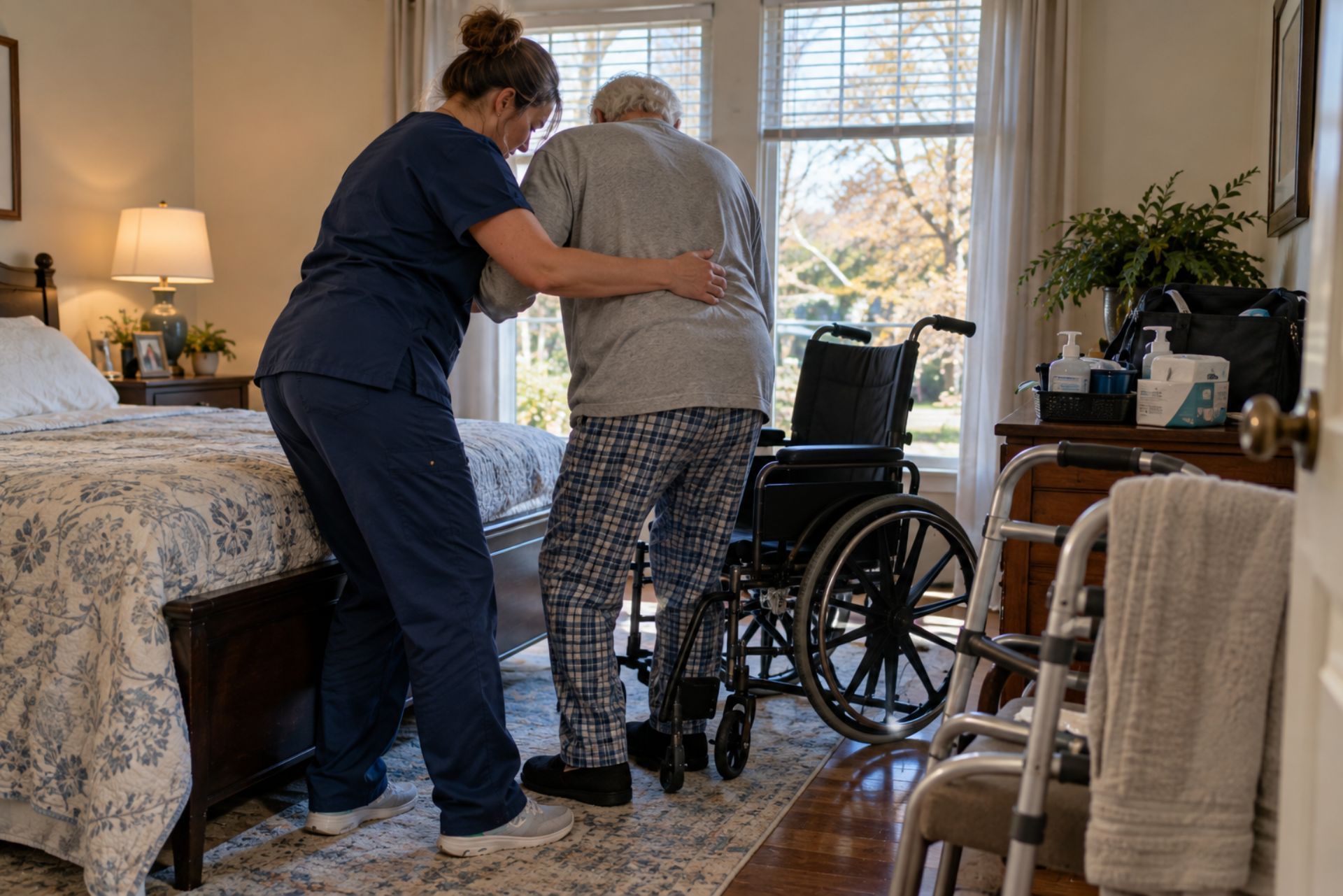
A caregiver lifts a 180-pound patient from a wheelchair to a bed, feels a sharp pop in her lower back, and cannot finish her shift. A home health aide driving between client visits on Route 50 in Fairfax is rear-ended at a stoplight and suffers whiplash. These are not hypothetical situations; they are the kinds of injuries that Virginia
home health agencies face every week.
Workers' compensation insurance for Virginia home health agencies is not merely a regulatory checkbox: it is a financial safeguard that protects your caregivers, your patients, and your business from the cascading costs of workplace injuries. Virginia law mandates workers' compensation coverage for any business with three or more employees, and home health agencies almost always exceed that threshold. Understanding how caregiver injuries, patient transfers, driving risks, class codes, payroll audits, and claims interact with your policy can mean the difference between a manageable premium and a budget-breaking surprise. The stakes are high, and the details matter. This guide is designed to help Virginia home health agency owners and administrators build a workers' comp program that is both compliant and cost-effective.
Virginia Workers' Comp Basics for Home Health Care
Home health care is one of the fastest-growing sectors in Virginia, and the physical demands placed on caregivers create a risk profile that insurers watch closely. Your workers' comp policy covers medical expenses, lost wages, and rehabilitation costs when an employee is injured on the job, whether that injury occurs inside a patient's home or on the road between visits. Virginia's workers' compensation system is administered by the Virginia Workers' Compensation Commission, and the rules governing benefits, reporting deadlines, and dispute resolution are specific to the Commonwealth.
State Requirements for Home Health Agencies
Virginia requires any employer with three or more employees to carry workers' compensation insurance. There is no exemption for home health agencies, and independent contractor misclassification is a frequent audit trigger. If your agency uses 1099 workers who function as employees under Virginia's legal tests, those individuals may be reclassified, and you could face back-premium assessments and penalties. The maximum weekly compensation rate for injured workers increased to $1,507 as of July 1, 2026, which directly affects the cost of claims and, by extension, your experience modification factor. Keeping your employee classifications accurate from the start protects you from costly surprises during an audit.
Common Hazards: Patient Transfers and Driving Risks
Two categories of injury dominate home health workers' comp claims. The first is musculoskeletal injuries from patient transfers: lifting, repositioning, and assisting patients in and out of beds, wheelchairs, and bathtubs. The Bureau of Labor Statistics consistently reports that healthcare support occupations have some of the highest rates of nonfatal workplace injuries, and home health aides are particularly exposed because they often work alone without mechanical lift equipment. The second major category is
motor vehicle accidents. Your caregivers drive between client homes throughout the day, often in Northern Virginia traffic corridors like I-66, I-495, and Route 7. Every mile driven is a mile of exposure, and auto-related workers' comp claims tend to be expensive because they frequently involve emergency care, imaging, and extended
physical therapy.

By: Venee Galloway, CPCU, CBIA, CLCS, SBCS
Director of Commercial Insurance
Your workers' comp premium is calculated by multiplying your payroll (per $100) by a rate assigned to your class code, then adjusting for your experience modification factor. Choosing the correct class code is not optional: it is a compliance requirement that directly affects what you pay.
Code 8835 vs. Code 8824: Choosing the Right Classification
Two NCCI class codes are commonly applied to home health agencies. Code 8835 covers home health care aides who provide personal care, bathing, feeding, and light housekeeping. Code 8824 applies to professional or skilled nursing staff, including registered nurses and licensed practical nurses who deliver clinical services. The rate for Code 8835 is typically higher because personal care aides perform more physically demanding tasks with greater injury frequency. If your agency employs both types of workers, your payroll should be split between codes rather than lumped under one classification. Misclassification in either direction creates problems: overpaying on premiums or facing a large audit adjustment.
How Payroll Audits Impact Your Final Costs
Every workers' comp policy in Virginia is subject to an annual payroll audit. Your insurer will compare the payroll you estimated at the beginning of the policy period against your actual payroll records. If your payroll grew because you hired additional aides, you will owe additional premium. If it shrank, you may receive a refund. Auditors also verify that employees are assigned to the correct payroll classifications, and any misclassified workers will be reclassified with the corresponding rate adjustment. Keeping clean, organized payroll records throughout the year is the single best way to avoid audit disputes.
Comparing Risk Management Strategies
Not every home health agency faces the same risk profile, and your approach to managing workers' comp costs should reflect your specific operations. The table below compares three common strategies.
| Strategy | Best For | Estimated Impact on Premium | Key Consideration |
|---|---|---|---|
| Mechanical lift equipment | Agencies with bariatric or immobile patients | 10-20% reduction in transfer-related claims | Requires training and patient-home assessments |
| Telematics for fleet vehicles | Agencies with high driving exposure | 5-15% reduction in auto-related claims | Monitors speed, braking, and route efficiency |
| Return-to-work programs | All agencies | Reduces claim duration and total cost | Must comply with Virginia medical treatment guidelines |
Combining multiple strategies tends to produce the best results. An agency that invests in both lift equipment and a structured return-to-work program will likely see a lower experience modification factor over time, which compounds premium savings year after year.

How Virginia's 2026 Rate Changes Affect Your Agency
The Virginia Workers' Compensation Commission publishes updated benefit rates annually, and the 2026 adjustments carry real financial implications for home health agencies. The
cost-of-living adjustment for 2026 increased maximum weekly benefits, which means that claims involving lost wages will cost more on a per-claim basis. For agencies with a history of claims, this translates into upward pressure on experience modification factors. The broader workers' comp market remains financially healthy heading into 2026, but individual agency premiums are driven more by your own loss history than by market-wide trends. Reviewing your claims data with your
insurance agent before your renewal date gives you the opportunity to address any correctable issues.
A well-managed claims process protects your employees and your bottom line. Virginia has specific procedural requirements that differ from neighboring states like Maryland and the District of Columbia.
Reporting Caregiver Injuries Promptly
Virginia law requires employers to report workplace injuries to their insurance carrier within 10 days of learning about the injury. Delays in reporting are one of the most common mistakes home health agencies make, often because caregivers working in the field do not immediately inform a supervisor. Establishing a clear, simple reporting protocol: a dedicated phone number, a mobile app, or even a text-based system: ensures that injuries are documented quickly. Late reporting increases claim costs because it delays medical treatment and gives insurers less time to investigate.
Managing Return-to-Work Programs
A structured return-to-work program brings injured caregivers back to modified duties as soon as they are medically cleared. This might mean assigning a recovering aide to scheduling, care plan documentation, or client intake calls rather than patient transfers. Virginia's workers' comp system supports transitional duty arrangements, and claims data consistently shows that employees who return to some form of work within two weeks of an injury have shorter overall claim durations. The compensation chart for various injury types illustrates why keeping claim durations short matters: permanent disability awards can reach six figures, making early intervention a financial priority.
Frequently Asked Questions
Do part-time home health aides need to be covered by workers' comp in Virginia? Yes. Virginia's workers' comp requirement is based on the total number of employees, not their hours. If your agency has three or more employees, all of them must be covered regardless of part-time or full-time status.
Are driving injuries covered under workers' comp for home health aides? Injuries sustained while driving between client visits during work hours are generally covered. Commuting from home to the first client or from the last client to home may not be covered, depending on the circumstances.
How often do payroll audits happen? Most carriers conduct an annual audit at the end of each policy period. Some insurers may request interim audits for agencies with rapidly changing payrolls.
Can I reduce my experience modification factor? Yes. Reducing claim frequency and severity over a three-year rolling period will lower your experience mod. Investing in safety training, proper equipment, and return-to-work programs are the most effective methods.
What happens if I misclassify an employee's class code?
The auditor will reclassify the employee and adjust your premium accordingly. Repeated misclassification can result in penalties and may affect your ability to obtain coverage.
Choosing the Right Insurance Partner for Your Agency
An independent insurance agency can compare policies from multiple carriers on your behalf, which is especially valuable for home health agencies because not every carrier underwrites this class of business. ABP Insurance Agency, Inc., based in Fairfax, Virginia, works with over 25 carriers and has a staff with more than 150 years of combined experience in commercial insurance. For agencies serving diverse communities in Northern Virginia, ABP Insurance Agency, Inc. also provides support in nine languages, including Spanish, Vietnamese, Korean, and Mandarin, ensuring that policy details are communicated clearly to all stakeholders.
Understanding Experience Modification Factors
Your experience modification factor, often called your "experience mod" or "e-mod," is a multiplier applied to your premium based on your agency's claims history relative to other businesses in the same class code. A mod of 1.0 means your claims experience is average. Below 1.0 earns you a discount; above 1.0 means you pay a surcharge. For home health agencies, a single serious back injury from a patient transfer can push your mod above 1.0 for three years. The
minimum and maximum benefit rates published by the Virginia Workers' Compensation Commission determine how much each claim costs the system, and those costs flow directly into your mod calculation. Monitoring your mod annually and disputing any errors in your loss runs is essential.
Safety Training That Actually Reduces Claims
Generic safety training does not move the needle for home health agencies. Your training program should focus on the two injury categories that generate the most claims: patient handling and driving. For patient transfers, hands-on training with gait belts, slide boards, and portable Hoyer lifts is far more effective than a PowerPoint presentation. For driving, a defensive driving course tailored to the stop-and-go conditions of Northern Virginia, where caregivers navigate congested corridors near Tysons Corner, Annandale, and Falls Church, addresses real-world risks. Tracking completion rates and refresher schedules demonstrates to your insurer that your agency takes loss prevention seriously, which can support requests for premium credits.
Workers' Comp and Employee Retention
High turnover is expensive for any business, but for home health agencies, it also increases workers' comp risk. New employees are statistically more likely to be injured during their first 90 days on the job because they have not yet developed the muscle memory and situational awareness that experienced aides possess. A strong workers' comp program, one that includes thorough onboarding, proper equipment, and a supportive claims process, signals to your workforce that their well-being is a priority. Agencies with lower turnover rates tend to have lower experience mods, creating a positive cycle that benefits both employees and the business.
Protecting Your Agency and Employees
Workers' compensation insurance is not a cost to be minimized at all hazards: it is an investment in the stability and reputation of your home health agency. The right policy, paired with accurate class codes, clean payroll records, proactive safety training, and a structured claims process, positions your agency to manage risk effectively while keeping premiums under control. Virginia's 2026 benefit rate increases make it more important than ever to review your coverage before your renewal date, verify your experience modification factor, and address any gaps in your safety program. ABP Insurance Agency, Inc. has earned
120+ five-star Google reviews
by helping Virginia businesses find the right coverage at competitive rates. If your agency is due for a policy review or you are shopping for a new workers' comp program,
get in touch with one of their multilingual agents to compare options from multiple carriers and build a program that fits your agency's specific needs.
Our Reviews
Trusted Advice, Proven Results
See what our clients have to say about their experience working with us, or share feedback about your experience.

PERSONAL INSURANCE
Protect What Matters Most
Home, auto, and life coverage at competitive rates from 25+ carriers.
Home Insurance
Covers your home and belongings from events like fire, theft, or storms. Ensures peace of mind with clear, reliable coverage for houses, condos, apartments, and rentals
Auto Insurance
Covers vehicle repairs, liability, and medical costs from accidents. Protects you and your car with easy-to-understand policies that meet Virginia requirements.
Umbrella Insurance
Provides extra liability coverage beyond home and auto policies. Adds protection for unexpected situations that exceed your standard policy limits.
Renters Insurance
Covers your personal belongings and provides liability protection if you rent your home. Replaces items damaged by fire, theft, or water at a low monthly cost.
Condo Insurance
Fills the coverage gaps your HOA master policy leaves open. Protects your unit's interior, personal property, and liability from covered losses.
Classic & Specialty Vehicles
Coverage for classic cars, motorcycles, ATVs, boats, and RVs. We partner with specialty carriers like Hagerty to protect vehicles that standard auto policies do not cover.
BUSINESS INSURANCE
Secure What You've Built
Coverage solutions for growing companies backed by decades of commercial experience.






INDUSTRIES WE SERVE
Virginia's Businesses We Protect
Insurance solutions to help Virginia businesses protect their assets, employees, and operations.



FAQs
Your Questions, Answered
Explore our FAQs to get answers to some of the most common questions about our insurance solutions and services.
What languages do your agents speak?
We have agents who are fluent in Spanish, Vietnamese, Mandarin, Cantonese, Korean, Hindi, Urdu, and Punjabi. If you prefer a language other than English, just let us know!
Who do you typically work with?
We work with clients at all stages of life—from young professionals and growing families to high-net-worth individuals and retirees. We work with both small and large companies. No matter where you are on your journey, we can provide insurance solutions that align with your needs.
How do I get started?
It’s easy! Simply click here to get started. From there you will be able to seamlessly transfer your current coverage information to us or answer a few questions and one of our agents will be in touch.
How do you charge for your services?
We never charge fees for our service. As independent agents, we are paid by the insurance company after the policies you select are issued. Our compensation is a small percentage of the policy premium.
What makes ABP Insurance different from other insurance providers?
ABP Insurance is an independent agency. We work with over 25 insurance carriers to find the best coverage and rates for your needs. We do not represent a single company — we represent you. Our team also speaks nine languages, making us one of the most accessible agencies in Northern Virginia. We combine modern technology with personal service so clients get fast quotes, clear explanations, and ongoing support throughout their policy term.
What areas does ABP Insurance serve?
Our office is in Falls Church, Virginia, and we serve clients throughout Northern Virginia, the greater D.C. metro area, and beyond. We currently write policies in Virginia, Maryland, Washington D.C., Massachusetts, New Hampshire, Maine, Georgia, Texas, and North Carolina. Because we work with many of the largest national carriers, we can often help clients who own property in multiple states or who are relocating.
Contact Us
Phone Number:
703-846-0558
Email Address:
info@abpinsurance.com
Located at: 8315 US-29 Ste 215, Fairfax, VA 22031, United States
In-Person by Appointment Only